
How to Manage a Poker Bankroll in 2026 (Cash, MTT, Home Games)
A practical, math-backed guide to bankroll management for poker players in Europe and worldwide — buy-in rules, stop-loss, currency, and tracking.
Bankroll management (BRM) is the single biggest predictor of whether a winning player stays winning. Skill puts you in the green. BRM keeps you there through variance. I've watched objectively strong players go broke twice in one year because they treated the roll as a suggestion, and average grinders last a decade because they treated it as a business. This guide is the business plan.
What is a poker bankroll, really?
Your bankroll is the money you have set aside *only* for poker. Not your rent. Not your "fun money". A dedicated, separate balance you can track to the cent. If you can't say what your bankroll is right now within 5%, you don't have one.
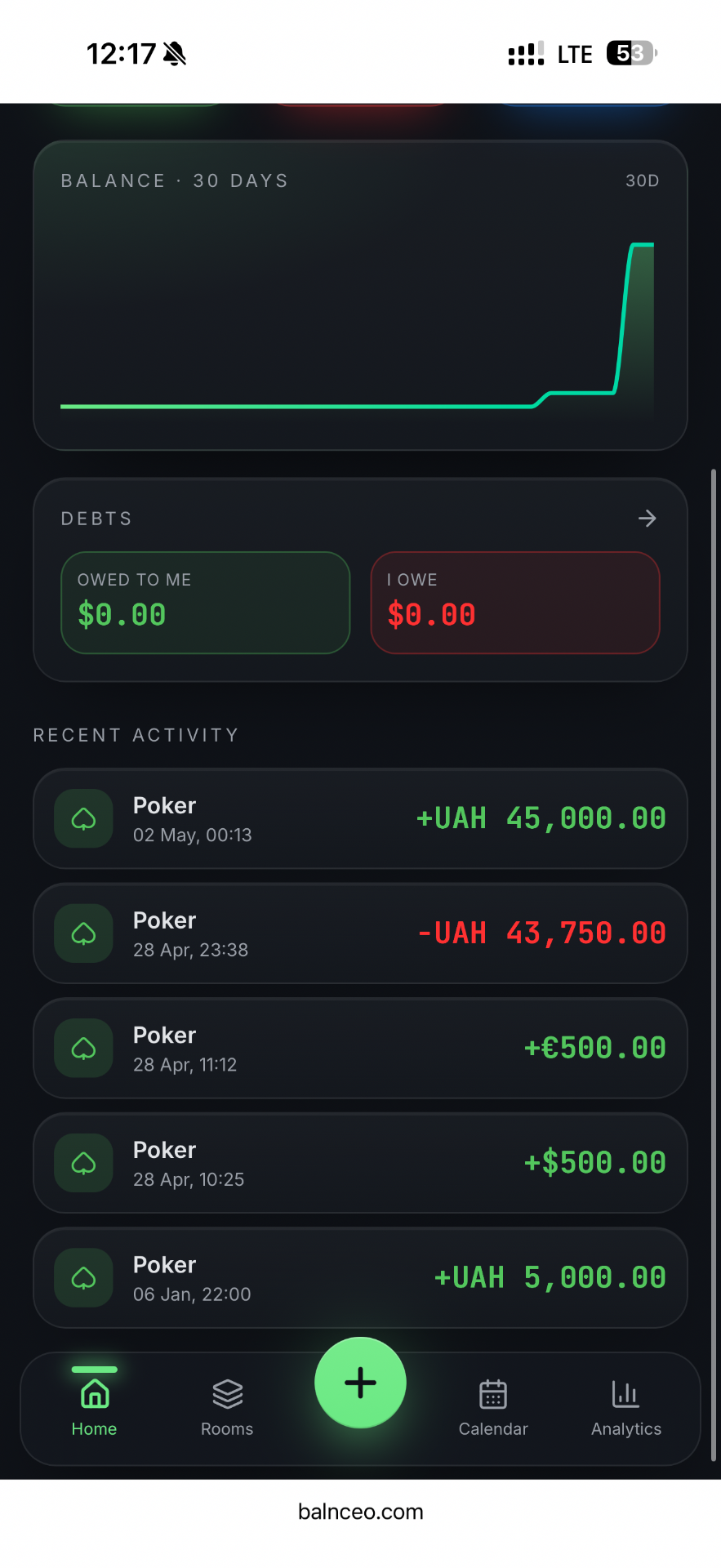
Two properties turn a pile of cash into a bankroll. First, the firewall: losing the entire roll must hurt your poker, not your life. The moment a session loss can reach groceries or the rent account, you're playing scared money, and scared money folds winners and calls losers because every pot feels like a bill. Second, measurement: every session moves the number, and you know the number after every session. A bankroll you can't state precisely is a hope, not a bankroll.
Buy-in rules that actually hold up
The classic rules are still close to optimal for most recreational and semi-pro players:
- NL cash (live): 20–30 buy-ins for the stake you play. €1/€2 with a €200 buy-in → at least €4,000–€6,000 dedicated.
- NL cash (online): 30–50 buy-ins. Variance is higher because pools are tougher and pace is faster.
- MTTs: 100–200 buy-ins. Yes, really. Tournament variance is brutal.
- Spin & Go / hyper-turbos: 200+ buy-ins.
These numbers aren't tradition; they come from risk-of-ruin math. Take a solid live winner making 8 big blinds an hour at €1/€2 with an hourly standard deviation around €350. Over a year of regular play, that player is nearly guaranteed to see a 10-buy-in downswing somewhere, and a 20-buy-in downswing is entirely possible without playing a single hand badly. If the roll is 20 buy-ins, an ordinary bad stretch is a coin flip from ending it. At 30 buy-ins the same stretch leaves you wounded but seated. At 10 buy-ins you were never bankrolled; you were visiting.
Concretely: at €1/€2 with a €200 buy-in, 20 buy-ins is €4,000 and 30 is €6,000. At €2/€5 with a €500 buy-in, 20 is €10,000 and 30 is €15,000. If those numbers look large, that's the point — they're the price of treating poker as a business with a real survival probability instead of a lottery ticket with hole cards. The full table for live stakes, plus the formula to compute your own number, is in our guide to bankroll requirements for live cash games.
MTTs need 100–200 buy-ins because the payout curve is top-heavy: most of a tournament player's yearly profit comes from a handful of final tables. You can play 50 tournaments, cash five, min-cash four, and be down 40 buy-ins while making correct decisions throughout. Online cash sits between live and MTTs because the pools are tougher (lower true win rate) and the hands come 5–10× faster (more variance per hour of your life).
One legitimate exception deserves plain language: if you have a stable income and can genuinely reload without pain, your effective bankroll is your monthly poker budget, and a smaller roll is rational. That's fine — just call it what it is, and don't confuse a reloadable hobby budget with a professional roll.
If you can't meet the requirement for your stake, drop a stake. There is no ego prize for going broke at €1/€2, and there is real money in being over-rolled at €0.25/€0.50.
Plan the downswing before it happens
A downswing plan written while you're winning beats every mindset trick invented while you're losing. Pre-commit to three numbers:
- Drop a stake when the roll falls below 20 buy-ins of the current game.
- Take a shot at the next stake only when you reach 30 buy-ins for it.
- Stop and review if you drop 15 buy-ins from your peak without an obvious explanation.
Write the numbers down somewhere you'll see them. The version of you that is stuck eight buy-ins this month will negotiate. The version that wrote the rules won't. If the downswing arrives anyway, the downswing survival guide walks through the statistics and the protocols.
Stop-loss and stop-win
A stop-loss is a maximum loss per session — typically 2–3 buy-ins. When you hit it, you leave. Tilt is real and measurable; the equity you give up after losing 3 buy-ins in one session is enormous.
A stop-win is more controversial but useful in live cash where game quality drops late at night and the loose money has gone home. Setting both numbers before you sit converts an emotional midnight decision into an administrative one. The evidence and the edge cases are in our stop-loss and stop-win guide.
Multi-currency reality in Europe
If you live in the EU and travel, you'll inevitably mix EUR, PLN, CZK, UAH, GBP. Pick a base currency and convert every session at the rate of that day. Don't wait until year-end — your true ROI gets buried in FX noise. A Prague weekend in CZK and a home game in EUR are the same bankroll only after conversion, and 3% of FX drift looks exactly like a 3% leak in your game. Log in the currency you played, convert at the daily rate, review in the base currency.
Keep the three worlds separate
Home games, online and casino play have different rake, different toughness and different variance. Even if the money lives in one roll, the records shouldn't blur: tag every session by environment and review the split monthly. Most players who do this discover they're a winner in one world and a donor in another — and the honest response is to shift volume, not to average the numbers and feel fine. The differences run deeper than rake; see home game vs online vs casino bankroll.
One rule applies everywhere: never count uncollected home-game debts as bankroll. €400 that a friend owes you is not €400. It's a receivable with a friendship attached.
The mistakes that actually kill bankrolls
- Scared money. Playing a stake where losing two buy-ins affects your month. You will fold too much and bluff too little, guaranteed.
- Mixing life roll and poker roll. One account, one number. The moment poker money pays a bill, every win rate you compute becomes fiction.
- Ignoring FX. Three currencies, no daily conversion, and your true ROI is buried in exchange noise.
- Counting debts. See above. Only paid debts are bankroll.
- Moving up after a heater. A 10-buy-in winning month is mostly variance. Move up when the roll and the sample say so.
- No stop-loss. The equity you bleed in the hour after losing three buy-ins dwarfs whatever you might win back that night.
Tracking is non-negotiable
You can't manage what you don't measure, and in poker you also can't *diagnose* what you don't measure. A 12-buy-in downswing with detailed logs is a study problem. The same downswing with no logs is just pain.
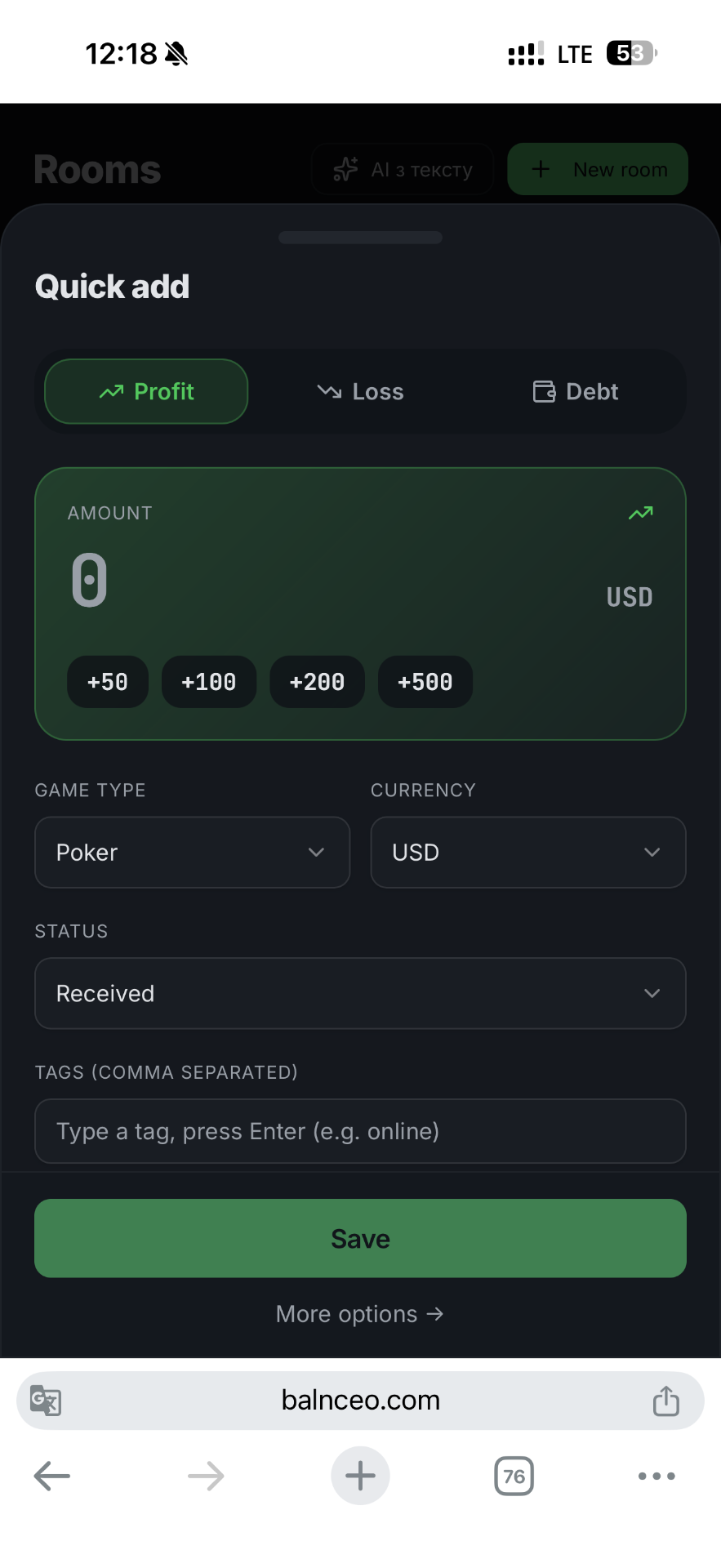
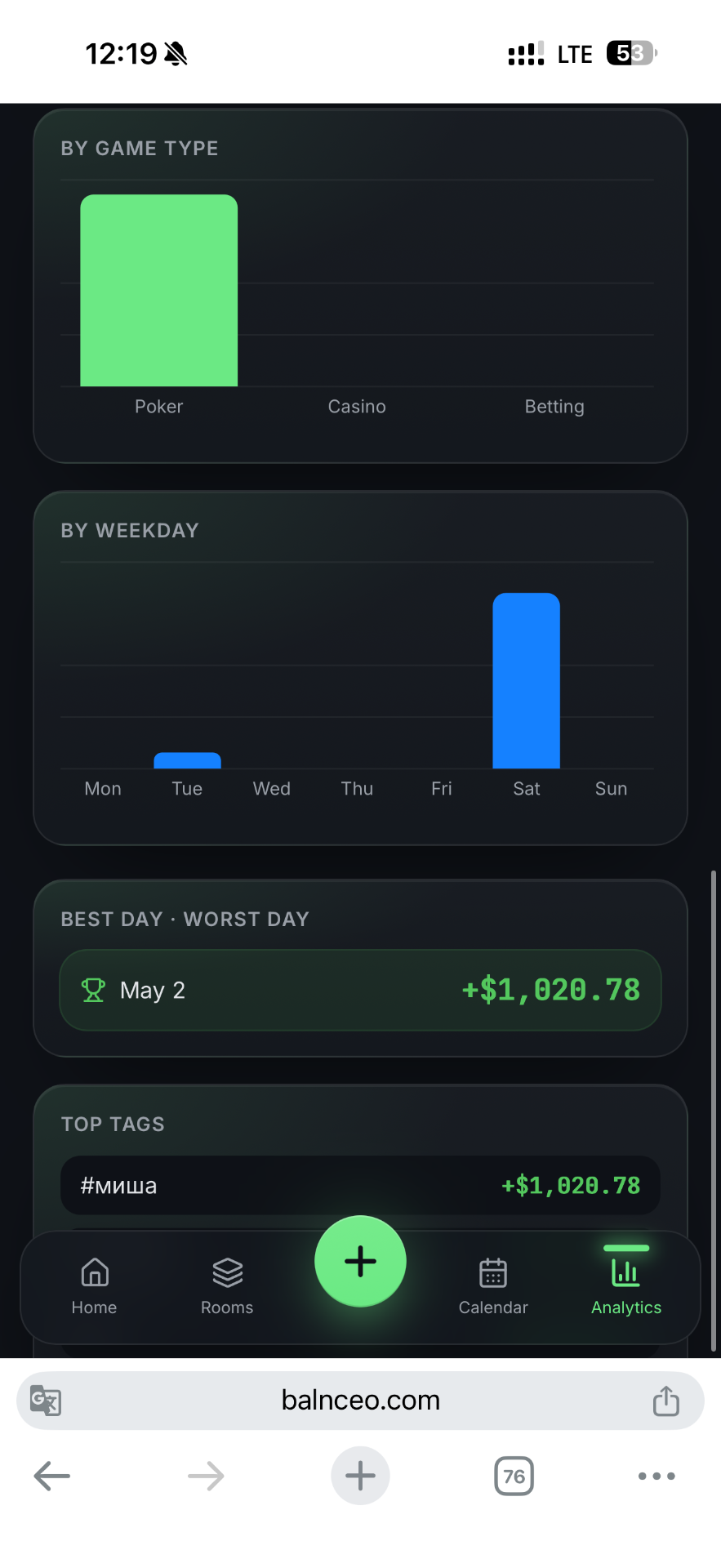
Record, at minimum: date, stakes and game type, venue, duration, total buy-in, final cash-out, and one line of notes — game quality, why you quit, how you felt you played. Duration matters more than players expect, because hourly rate is the only fair comparison between a €1/€1 home game and a €2/€5 casino table. Notes matter because six months later they tell you whether that brutal Friday was a leak or just weather. Tools like Balnceo make the whole thing a ten-second habit with automatic currency conversion, and the poker bankroll tracker page shows what the data looks like once it accumulates.
Move up by rule, move down by rule
Moving up requires three things at once: the buy-ins (30 for the new stake), the sample (at least 200 hours at your current stake with a clearly positive hourly), and a shot plan — typically five buy-ins of the new stake with exit conditions written before you sit. Lose them and you drop back without debate. The full framework is in our shot-taking rules.
Moving down is where egos go to die, and it's the same rule in the other direction: the bankroll decides, you comply. Players who treat moving down as failure stay at a stake they're no longer bankrolled for, and the math finishes what pride started.
The takeaway
Be the CEO of your bankroll. Set rules before you sit down, log every session, and review weekly. Tracking does not guarantee better results, but it gives you an honest record for decisions about stakes, limits, and study.