
How to Track Poker Debts in a Home Game (Without Losing Friends)
How to track poker debts without losing friends: why memory and group chats fail, IOU etiquette, reminder timing, multi-currency groups, and write-offs.
Learning how to track poker debts properly is what separates home games that run for five years from games that quietly die after one awkward season. The cards are never the problem. The problem is the €120 that Rui has owed Petra since March, that Petra remembers as €150, and that Rui is fairly sure he already paid back. Multiply that by six regulars and a full season, and you don't have a poker game anymore. You have a small claims court with a dealer button.
Why memory and group chats fail
Human memory edits itself. People remember debts they're owed about 20% larger than they were, and debts they owe about 20% smaller, and both sides are honestly wrong. After three weeks, even the existence of a debt gets fuzzy: "didn't you transfer me that after the game at Jon's place?"
The asymmetry is the toxic part. The creditor remembers the debt every time they see the debtor. The debtor genuinely forgets it within days. So one side experiences months of quiet resentment while the other experiences nothing at all, and when it finally surfaces, it surfaces as an accusation instead of a reminder.
Group chats are worse, because they feel like records and behave like memory. The IOU gets announced between a meme and a pizza order, scrolls out of view by Sunday, and finding it again means scrolling through nine weeks of "running 15 late" messages. I've been in a chat where the same €60 debt was announced twice and paid zero times, because each announcement looked like it referred to the other one.
The spreadsheet trap
The natural next step is a shared spreadsheet, and it works for about a month. Then:
- The owner is the only one who updates it, and the owner goes on holiday.
- Someone adds a column for nicknames and breaks the totals formula.
- Three people edit it from their phones and two of them overwrite each other.
- Nobody can answer the only question that matters — "what do I owe, total, right now?" — without five minutes of cross-referencing tabs.
The spreadsheet fails for a structural reason: poker debts are directional (A owes B, not "A and B have a €60 thing"), they have a status (open, partially paid, settled), and they have a history. A grid of numbers captures none of that.
IOU etiquette: when and how to remind
Rules that have kept my game friendly:
- Under €20: settle next game in cash. Don't chase it.
- €20–€100: a friendly reminder at seven days, framed as logistics rather than accusation. "Hey, still open from Friday, want me to send my IBAN?" works. "You owe me" doesn't.
- Over €100: same week, by transfer, and it's fine to say so on the night.
- Thirty days: any debt older than 30 days gets a direct, private conversation. Not in the group chat. Nine times out of ten it's genuine forgetfulness, and the private message preserves the friendship. The tenth time is information you need about whether that player gets credit again.
- Cap credit at one buy-in per player. No exceptions for charm. The person who owes you two buy-ins will not pay you back faster because you lent a third.
How to track poker debts the boring, reliable way
The system that survives is the one that takes ten seconds at the end of the night, while everyone is still at the table and the numbers are warm:
- At settle-up, say each debt out loud: "Rui owes Petra €120." Both parties confirm. This two-second confirmation eliminates 90% of later disputes.
- Log it immediately: creditor, debtor, amount, currency, date, and which game it came from.
- When it's paid, mark it settled the same day. A debt that's paid but still listed as open is how "I already paid you" arguments start.
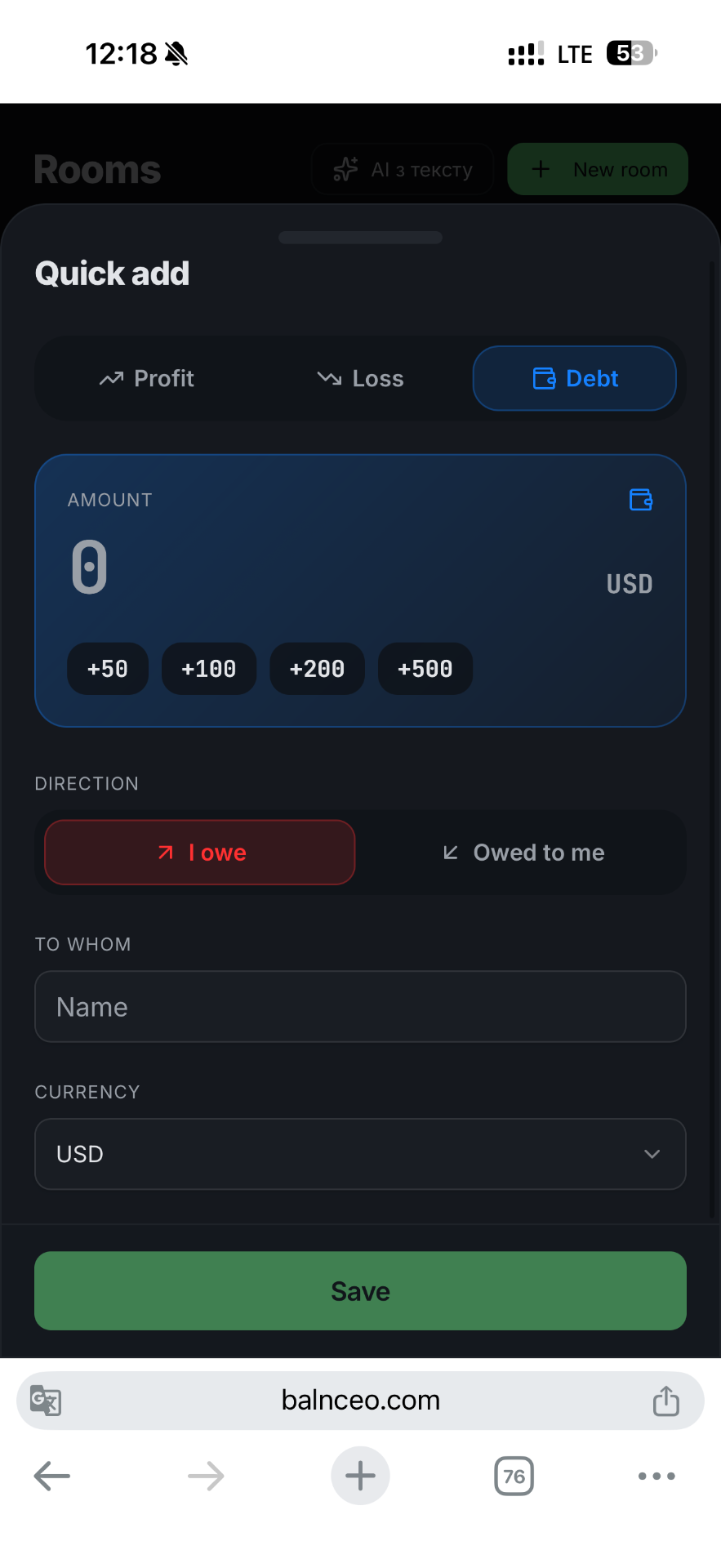
I log mine in Balnceo's home game tracker, where a debt has a direction, an amount, a currency and a status, and marking it settled is one tap. The free apps are available on iOS and Android, which matters because the logging happens in the doorway as people leave, not at a desk the next morning.
If the night itself is messy, with several players up and down, run the numbers through the settle-up calculator first so you're logging three clean debts instead of nine tangled ones. There's a full walkthrough of that process in the guide on splitting poker winnings fairly.
Multi-currency groups
If your game mixes currencies — expats, cross-border regulars, a game that alternates between cities in two countries — pick one base currency per debt and stick to it:
- Record the debt in the currency of the game it came from. A €120 debt stays €120.
- If someone repays in another currency, convert at that day's actual rate and log the settled amount in the original currency. "He paid me about £100" is how a €120 debt becomes a permanent €15 argument.
- Never let the same debt drift between currencies across weeks. Exchange rates move 2–3% in a bad month, which on a €300 debt is real money.
A concrete example from our game: a player owed €120 from a Berlin night and wanted to repay in pounds two weeks later. The rate that day put €120 at about £102. We logged the original €120 debt as settled with a note of the £102 received. If we'd instead re-denominated the debt into pounds on the night and converted back later, the two conversions would have created a phantom €5–10 difference that someone would have to absorb — and argue about.
When to write a debt off
Once a season, review anything older than 90 days. If someone owes €35, has stopped coming, and has ignored two private messages, write it off: mark it settled, note it privately, stop lending to that person, and move on. Chasing €35 for six months costs more than €35. The write-off isn't generosity; it's bookkeeping hygiene. Your ledger should only contain debts that are real.
FAQ
How soon should I remind someone about a poker debt? Seven days for anything over €20, phrased as logistics ("want my bank details?"). Immediately for anything over €100. Never in the group chat.
What if someone denies a debt exists? This is exactly why debts get confirmed out loud at the table and logged the same night. If there's no record anywhere, you eat it once and fix the process going forward.
Should I charge interest on poker debts between friends? No. Interest turns a friendship problem into a legal-flavored one. The correct sanction for slow payment is no more credit, not 5% APR.
How do I handle partial payments? Log them. A €120 debt paid €50 is a €70 debt, not "mostly settled." Partial payments without a record are the top source of "I thought we were square" disputes.
What's the best way to settle across borders? Instant transfer apps beat cash for international groups because the exchange rate is visible at the moment of payment. Agree beforehand which currency the debt lives in, and let the payer's app show the conversion.